Oct 16, 2026Buying Guides
Private Label or New Tooling? How to Choose Your Product Development Route
Compare existing-model branding, component changes and new tooling before sourcing from China. Learn what each route means for samples, costs, MOQ and approvals.
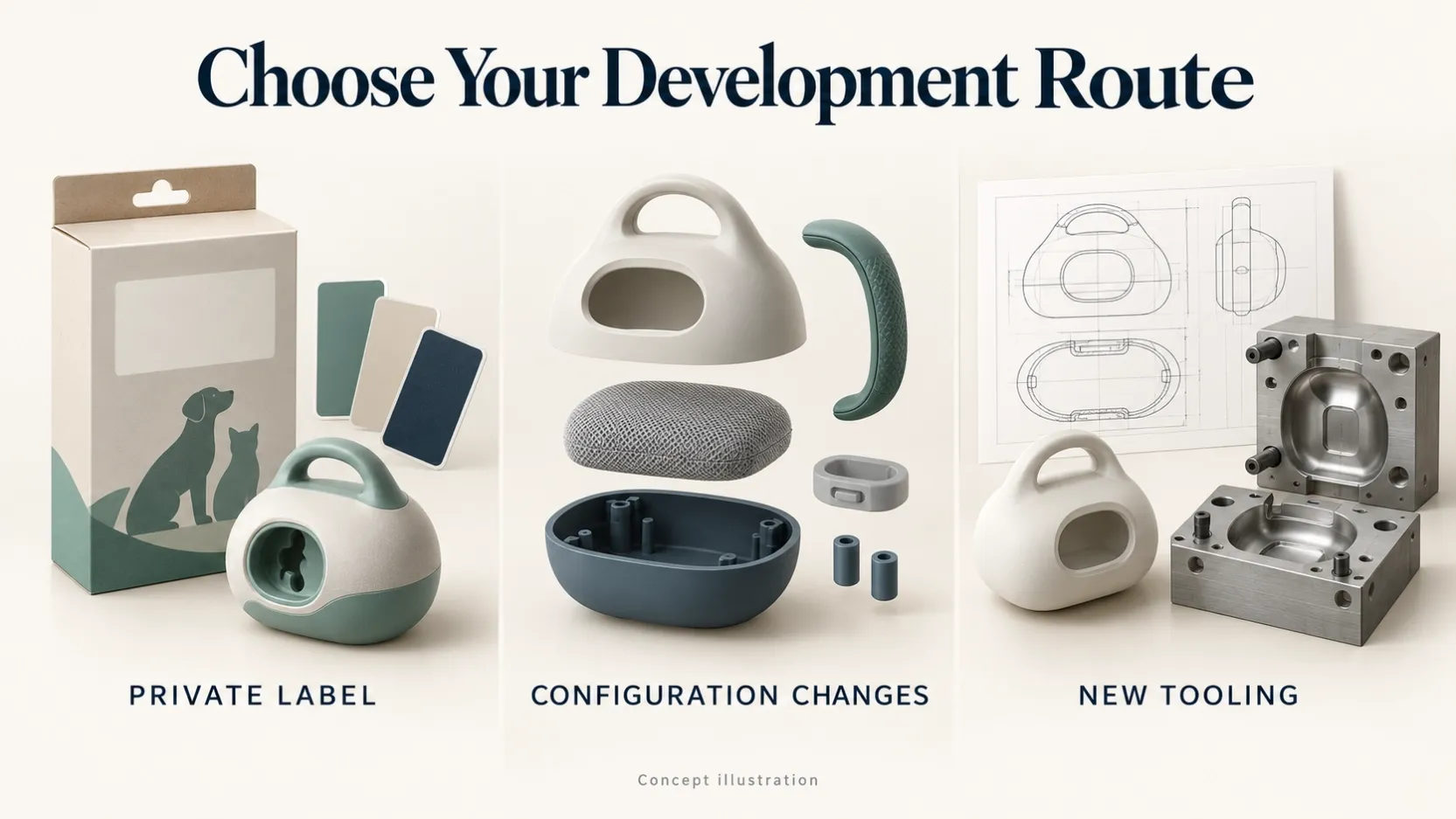
When preparing a new baby or pet product collection, buyers often begin with the same question: should we customize an existing product or develop something new?
The answer depends on what must change to make the product suitable for your customers. A new logo may require artwork approval. A different handle, base or folding mechanism may require engineering review. A new structure may involve tooling, several sample rounds and additional verification.
Before comparing supplier quotes, define the changes you need—and ask which development route each supplier is actually quoting.
Three Routes to Consider
The terms “OEM,” “ODM” and “private label” are not always used consistently. A practical comparison should describe the work involved rather than rely on those labels alone.
Development route | Typical scope | What buyers should confirm |
|---|---|---|
Existing-model private label | An existing product with agreed branding, colors, labels or packaging | Available options, MOQ by variant, artwork requirements and sample approval |
Component or configuration changes | Changes to selected materials, accessories, components or functions | Compatibility, whether tooling is affected, testing needs and revised specifications |
New structure or tooling | A new shape, mechanism, molded part or substantially different construction | Engineering scope, tooling responsibilities, sample stages, validation and production readiness |
These are planning categories, not fixed packages. A change that looks small may affect several parts of a product.
Route 1: Use an Existing Model and Customize the Brand Presentation
This route can be appropriate when an existing product already meets the main functional requirements of your target customers.
Possible changes may include:
- Logo application.
- Available colors or agreed custom colors.
- Printed artwork.
- Retail packaging.
- Instructions, SKU labels and carton marks.
- An agreed accessory bundle.
The advantage is that buyers may be able to focus development work on brand presentation and order specifications rather than creating a new structure.
However, “existing model” does not mean every customization is immediately available or included in the quoted price.
Custom colors can create material minimums. A different logo method may require setup work. New packaging can change carton dimensions, packing costs and shipping volume.
Product example: a private-label cardboard cat sofa
For a cardboard cat sofa, brand artwork and packaging may be a suitable starting point if the existing size and structure meet your needs.
Changing the dimensions or connection points is a different request. It may require revised cutting layouts, an assembly review and updated packing measurements.
Our Custom Corrugated Cardboard Cat Sofa Collection provides a product-specific reference for MOQ, sampling and flat-pack specifications. Those conditions should not be assumed to apply to every new design.
Choose this route when the existing product works for your intended use and your main objective is a differentiated brand presentation.
Route 2: Change Selected Components or the Configuration
Sometimes an existing model is close to what the buyer needs, but certain details must change.
Examples include a different fabric, accessory, closure, handle, base support or functional configuration.
This route sits between straightforward branding and a completely new product. It can be useful, but only when the supplier explains how the proposed change affects the rest of the design.
Before requesting a revised sample, ask:
- Can the change use an existing compatible component?
- Does it affect the fit or performance of neighboring parts?
- Does it require a new mold, cutting tool, fixture or other production setup?
- Will the product’s weight, packed dimensions or assembly process change?
- What verification is required for the revised configuration?
A supplier should not treat a change as purely cosmetic if it affects how the product functions.
Product example: reviewing an EVA pet carrier
An EVA pet carrier’s appearance alone does not establish how it will perform in use.
If your requirement concerns shell support, base structure or usable internal space, ask the supplier to assess the specific model and proposed changes. A color sample cannot demonstrate that a structural requirement has been met.
Use the EVA Pet Carrier Collection as a starting point for model selection, then identify which requirements can be met by an existing configuration and which need further development.
Choose this route when an existing platform is suitable, but a clearly defined change is necessary for your product brief.
Route 3: Develop a New Structure or Invest in Tooling
New tooling may be worth considering when the required function, shape or construction cannot be achieved using a suitable existing design.
The decision should begin with a commercial and functional requirement—not simply a desire to make the product look different.
Ask what the new development is expected to achieve:
- Solve a specific customer problem.
- Improve a defined aspect of product use.
- Fit a different size or space requirement.
- Introduce a meaningful structural feature.
- Support a product range that existing designs cannot provide.
Then ask the supplier to explain which development steps are required before production can be quoted with confidence.
Depending on the product, these steps may include design review, prototypes, tooling trials, revised samples and production-process checks. Not every project follows the same sequence.
Tooling questions to resolve before committing
Request written agreement on:
- What the tooling quotation includes.
- Which drawings or specifications define the approved scope.
- Who owns the tooling and any associated design files.
- Whether exclusive use is included.
- Where the tooling will be stored.
- Responsibility for maintenance, repairs and modifications.
- How additional sample rounds or design changes are charged.
- What happens if the project is paused or discontinued.
- Any agreed conditions for transferring or releasing the tooling.
Paying a tooling fee does not, by itself, explain all of these arrangements. They should be stated in the project agreement.
Choose this route when a defined product requirement justifies the development investment and you can accommodate the necessary review and validation stages.
Compare the Full Development Scope, Not Just the Unit Price
Two quotations may describe a similar product while including different work.
One may cover an existing model with standard packaging. Another may include custom components, a new retail box and additional sample development.
Before deciding which offer is less expensive, compare the same scope.
Cost or responsibility | What to clarify |
|---|---|
Samples | Sample type, included revisions, shipping charges and any agreed bulk-order credit |
Tooling and development | Included work, payment stages and charges for changes |
Product configuration | Materials, components, functions and accessories |
Packaging | Artwork, printing, labels, instructions and packing method |
Verification | Required checks or testing, responsible party and quoted scope |
Inspection | Inspection stage, criteria, booking arrangements and fees |
Delivery | Production completion, shipping preparation, transport and destination responsibilities |
For a broader checklist, see How U.S. Buyers Can Compare Chinese Supplier Quotes—and Avoid Missing Costs.
Match Sample Approval to the Development Route
A sample is useful only when everyone understands what it is intended to confirm.
An existing-model sample may help you evaluate size, handling and general construction. It does not automatically approve your custom artwork, packaging or revised components.
A development prototype may demonstrate shape or operation without representing the final production material or process.
Before approving any sample, record:
- The sample version and date.
- The features being reviewed.
- Any differences from the planned production specification.
- Accepted and rejected details.
- Remaining changes.
- Whether another sample is required before production release.
For new tooling or structural changes, ask which sample represents the intended production materials, tooling and assembly process.
Sample approval also should not be treated as a substitute for any applicable product verification or destination-market requirements.
Keep the First Launch Focused
A first collection does not need every proposed feature at once.
Divide your brief into three groups:
- Required for launch: features necessary for intended use, market requirements and customer expectations.
- Commercial priorities: features important to positioning, packaging or channel needs.
- Possible later improvements: changes that can be evaluated after the initial launch.
This helps suppliers separate essential work from optional development.
It can also help buyers avoid changing the product repeatedly after samples, materials or tooling have already been approved. Any later change should be reviewed for its effect on cost, timing and verification.
Do not postpone a necessary safety or compliance requirement to a later version.
Build the Schedule Around Approval Gates
A target launch date is not the same as a production-ready date.
Allow for the steps that apply to your chosen route: specification review, artwork, sample evaluation, revisions, tooling, verification, packaging approval and production preparation.
Ask the supplier to identify:
- What must be approved before each stage begins.
- Which decisions are required from your team.
- What is included in the quoted lead time.
- How revisions affect the schedule.
- Whether shipping time is quoted separately.
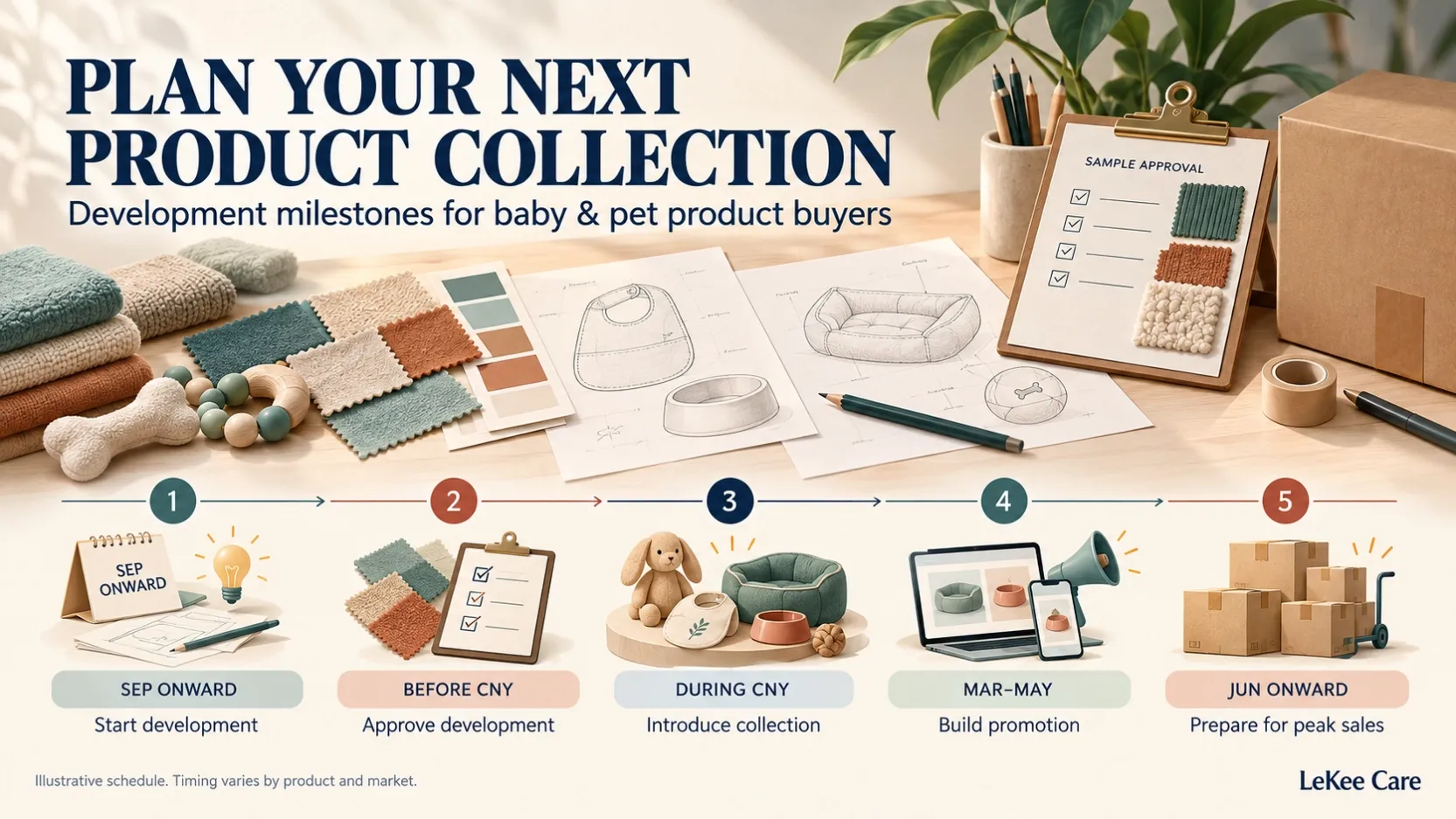
For buyers planning around Chinese New Year and the following sales season, our next-season product development planning guide explains how to connect development milestones with launch preparation and inventory planning.
What to Send Before Asking for a Development Quote
A useful development brief should include:
- Product category and reference model.
- Target market and sales channel.
- Intended use and target customer.
- Features that must remain unchanged.
- Requested changes, with pictures or marked-up references.
- Expected first-order quantity and quantity by variant.
- Target cost range and a separate development budget, if available.
- Branding and packaging requirements.
- Required arrival date.
- Known testing, documentation or retailer requirements.
If you are unsure which route is appropriate, ask the supplier to compare two clearly defined options—for example, an existing-model private-label version and a modified version with the required structural change.
Frequently Asked Questions
Does private labeling always avoid tooling costs?
No. Branding an unchanged existing model may not require new structural tooling, but certain logo methods, packaging formats or design changes may involve setup or tooling charges. Ask for an itemized quotation.
Can I begin with an existing model and develop a new version later?
Yes, this can be considered as a phased approach. Confirm the first version’s scope separately, and treat later structural changes as a new development review rather than assuming they are included.
Does a higher MOQ mean the product requires new tooling?
Not necessarily. MOQ can be influenced by materials, colors, components, packaging and production arrangements. Ask what drives the minimum for your specific configuration.
Will paying for a mold give us exclusive rights?
Do not assume so. Ownership, exclusive use, design rights and transfer arrangements should be explicitly agreed in writing.
Can one sample approval cover every color and packaging version?
Only if the approval scope explicitly covers those variations. Identify which details are approved by the sample and which require separate artwork, color or packaging confirmation.
Discuss the Route Before Committing to Development
The most useful first question is not “Can you customize this?” It is:
“Which of our requirements can use an existing model, and which require additional development?”
Send LeKee Care your reference product, required changes, quantity plan, target market and arrival deadline. We can review the proposed scope and discuss the appropriate next steps for the specific product.
For payment terms, sample charges and credits, and third-party inspection arrangements, review our Business FAQ.
Feasibility, MOQ, development charges, tooling arrangements and schedules are discussed case by case and confirmed in writing.